


March 25, 2026
L’ennemi fabriqué, nos cartes mentales et nous
Quand la polarisation devient notre paysage, comment créer une "Agreeculture" ?
Read More
When polarization becomes our landscape, how to create an "Agreeculture"?
We do not only inherit enemies. We fabricate them.
We fabricate them through rigid mental maps, closed narratives, loaded words, and ways of seeing that reduce others to caricatures, labels, and threats. That is why the problem of our time is not only how to collaborate in conflict, but how to stop manufacturing the enemy in the first place.
This article explores a Shapership perspective on polarization: before methods, there is perception; before transaction, there is recognition; before cooperation, there is the capacity to shift one’s point ofview.
Shapership proposes exactly that: a hygiene of perception, a way of making the invisible visible, of changing maps rather than merely changing course, and of reopening futures where fear had frozen the landscape.
Altitude Attitude names this conscious shift of viewpoint. Agreeculture names its relational translation: the active cultivation of the conditions under which recognition, movement, and cooperation can grow again.
How is it possible for situations that have been blocked for months, or even years, to suddenly unlock in just a few days?
The question applies to the political world, businesses, couples, teams, culture wars, identity conflicts, and wars full stop. It applies to all those situations in which human beings, trapped in positions that have become rigid, can no longer understand one another, bear one another, or imagine a workable path together.
We all know those moments when nothing moves anymore. Positions harden. Words become harsher. Camps form. The other becomes incomprehensible, unbearable, threatening, or simply “too much.”
The other then becomes the enemy.
And that is perhaps where the real problem begins.
Because the problem of our time is not only how to collaborate with the enemy. It is to see how quickly we fabricate the enemy.
Adam Kahane gave this problem a striking title: Collaborating with the Enemy. His thesis is powerful: in a world that is increasingly interdependent, complex, and polarized, peace, progress, and justice sometimes become impossible without the capacity to collaborate with people we disagree with, do not like, and do not trust. He offers a method that remains entirely valid.
But it is no longer enough.
Because, beyond the political, the economic, or the technological, the problem is also internal: violence begins long before weapons do — in words, in images, in postures, in narratives, and in mental maps.
Kahane sees something essential: we must learn to collaborate in conflict. But he sheds less light on what, upstream, fabricates the enemy in our perceptions, our narratives, our words, and our mental maps.
We ennemyfy.
We take a person, a group, or an idea and slide it into the category of the false, the dangerous, the ridiculous, the unacceptable. We turn divergence into opposition, opposition into disqualification, and disqualification into identity. Through a few shortcuts, a few words, a few mental automatisms, the other ceases to be a person. They become a block, a caricature, a box… a threat.
When points of view freeze, landscapes close. And when landscapes close, the “possibles” shrink.
From that moment on, the relationship is already almost lost. Curiosity declines. Complexity disappears. Language hardens. Listening becomes strategic or defensive. Nuances vanish. Reality itself becomes oversimplified.
All dialogue becomes impossible. It is replaced by more or less polite power struggles, tense coexistence, defensive tolerance, selfish strategy, and only rarely by an authentic encounter.
This is a colossal issue for our time, when everything feels unstable. Because if we fail at this stage, we produce a MAD World, a world of Massive Assured Destruction. A world in which debates become polarized, certainties harden, and clichés replace thought. Everything pushes toward simplification, tribalization, camp reflexes, blame attribution, and armed certainty.
One could say with Otto Scharmer that what then comes into view is a logic of absencing: inner conditions of ignorance, hate, and fear turning into patterns of denial, de-sensing, blaming, violence, and, ultimately, self-destruction.
In such a moment, polarization is no longer a peripheral accident. It becomes a dominant way of inhabiting the world.
Before any transaction, there is recognition.
Others are not reducible to the caricature our mental maps project onto them.
At the heart of relationships — and therefore at the heart of democracies, teams, organizations, and collectives — there is first of all a mental attitude, a posture of perception, a way of inhabiting difference.
In Humberto Maturana’s words, othering means failing to recognize others as “legitimate others.”
So first comes the recognition of the other’s value.
And, more fundamentally, recognition requires the capacity to see others differently from the caricature our mental maps project onto them, to see that they are not reducible to the label we place on them.
It is always on that ground that friendship, alliance, trust, and even fruitful disagreement are built.
Without this recognition, there may be compromise, transaction, calculation. There is rarely living cooperation.
We do not enter into relationship only on the basis of facts, but on the basis of narratives, associations, wounds, habits of interpretation, stereotypes, certainties, old emotions, automatisms of language, and worldviews. In a word: on the basis of an inner theatre that is often invisible to itself.
Hence the importance of working on the maps.
This is exactly where Shapership comes in and brings a decisive element, well beyond mere tools: a “hygiene” of perception, an ecology of perception, a creativity that is not there to “make things pretty” or to amuse, but to open up possibilities.
Shapership begins with a simple and radical intuition: if we recover the freedom to change our point of view, we recover movement. If we make mental maps visible — beliefs, dominant narratives, habits of perception, invisible borders of the thinkable — then we can restore suppleness where everything has become rigid and reopen the field of possibilities.
Without that opening, even if we are excellent navigators, we are condemned to keep sailing toward the same ports.
In other words, the real question is not only how to change course. It is how to change maps.
That is where the distinction between MAD Land and NO MAD Land — that NO turning the second MAD into Mutually Assisted Development — takes on its full meaning. If we recover the freedom to change our point of view, we recover movement. And if we recover movement, we recover the power to act on futures right now.
This is where Altitude Attitude comes in.
It is a height adopted in order to see differently, not to flee reality or float above it. Altitude Attitude is about seeing both the world as it is and as it could be.
It is the capacity to notice the point of view from which our attention arises, and to shift that point of view intentionally. It also means realizing that a slight shift in perspective can produce major differences in the landscapes we are able to perceive.
We can consciously choose our point of view in order to contribute to the world and to create the planetary human cooperation we need for the survival of humanity.
And yet cooperation — real cooperation — begins long before methods. It begins with a mental posture.
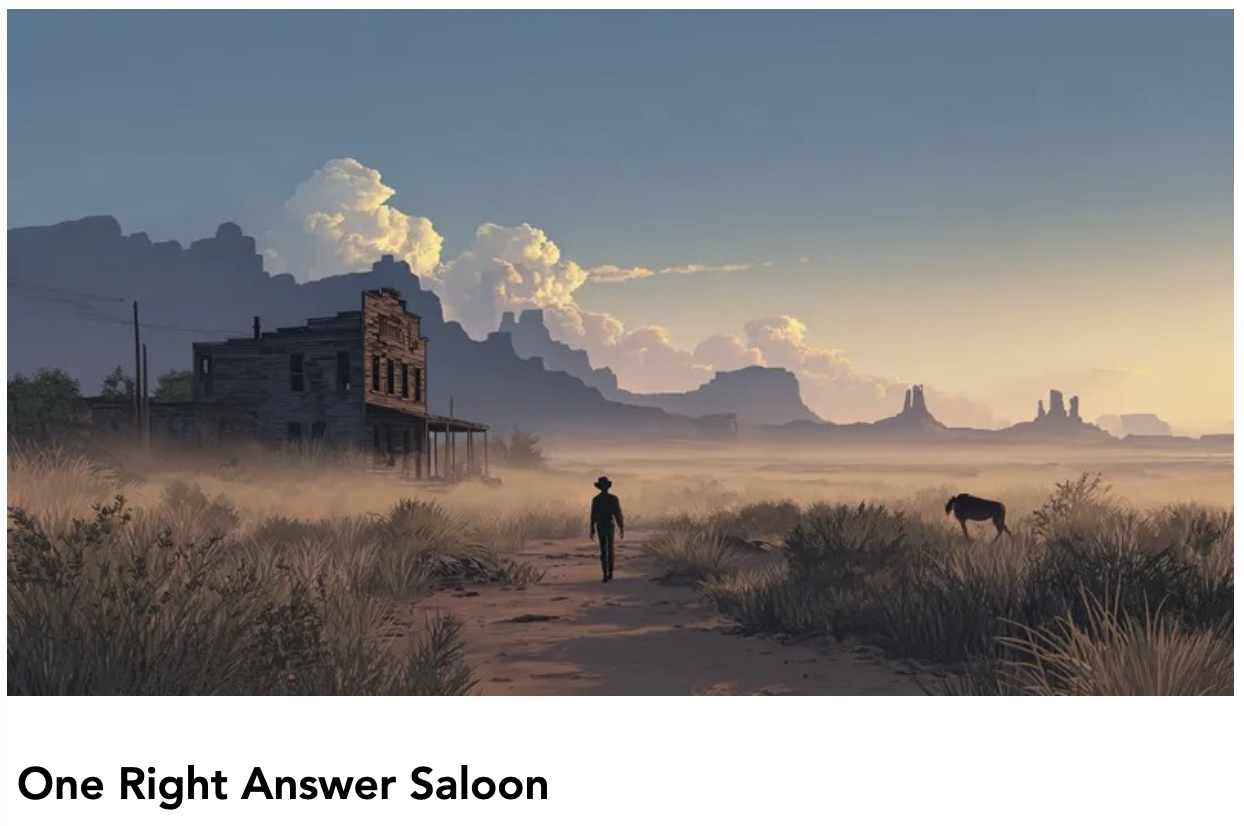
For example, I may step into what one might call the One Right Answer Saloon: that mental saloon in which everyone is convinced they know better, that they are right, and that the other is necessarily wrong. I then enter the relationship with the posture of the one who knows, who decides, who stands above, who hands out good and bad marks. From that point on, all dialogue becomes impossible.
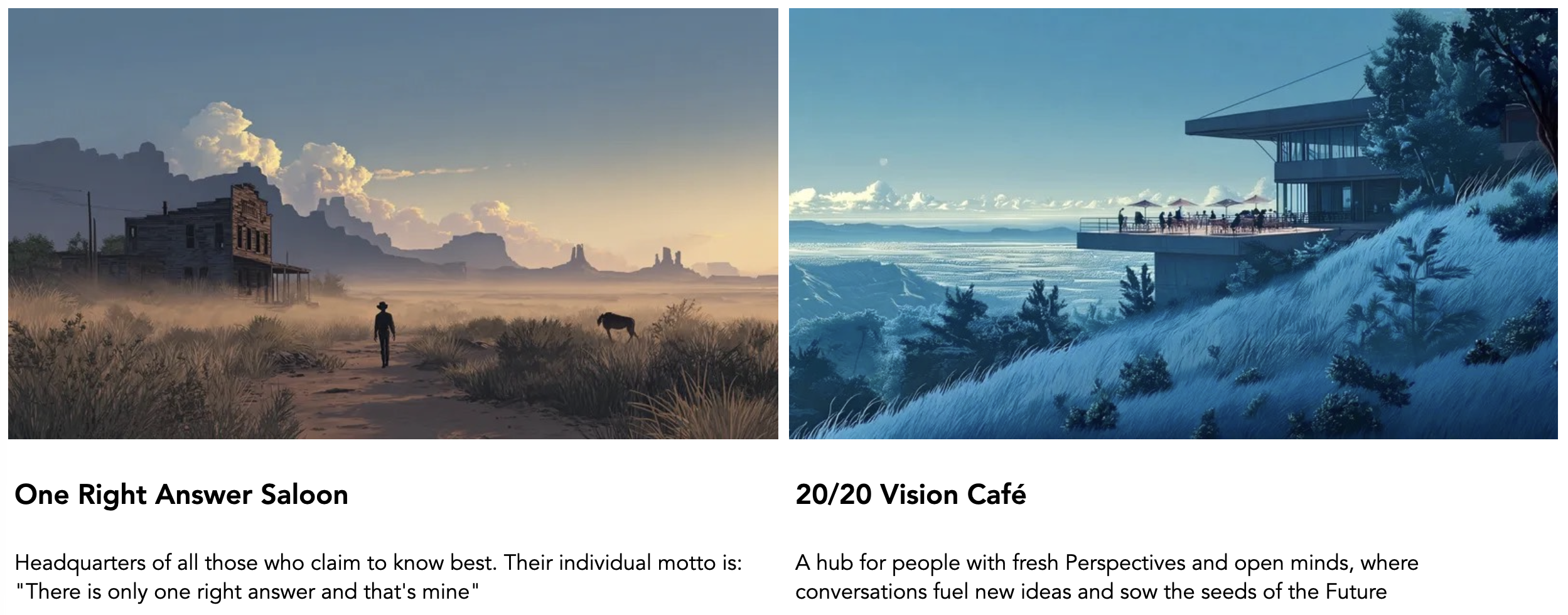
By contrast, if I setp into the 20/20 Vision Café , I enter with a lighter, more open, more provisional posture — a kind of proto-truth, an “I do not know enough yet,” an “I hold something, but not everything” — then everything changes. I do not disappear, and I do not give up my convictions. I simply stop turning my point of view into a prison. And that completely changes the quality of the relationship.
This process also passes through words, and words are far from innocent.
Words do not merely name things. They draw worlds. They create frames. They suggest paths. They close or they open. They wound or they connect. They freeze things or set them back in motion.
Two people can speak about freedom, respect, progress, justice, success, or love, and not inhabit the same world at all.
Same word, different landscapes.
That is why revisiting words is essential.
Here, creativity helps to unstick words from the automatisms they trigger, to give them back a playful dimension, space, and breath. It allows us to hear again what they can suggest — and also what they sometimes prevent us from seeing.
When we create the right word, we sometimes create a small clearing in the mental jungle.
A new word can open up new relational possibilities. words are, as we say in our ebook, Windows on the Words, eclectic vehicles to open new perceptions
That is exactly what a word like Agreeculture does.
Between agriculture and agree culture, there is more than a play on words. There is a proposition:
Agreeculture is the culture of the conditions for agreement: not forced agreement, not soft consensus, not uniformity, but the active cultivation of what enables different human beings to build common ground that is fertile for original approaches, new ways of thinking, doing, and acting.
A culture of “how do we move forward together, even imperfectly?”
This can be created upstream, before the negotiation itself, before the open crisis, and before positions turn into fortresses.
Creating an Agreeculture means preparing the relational ground. It means cultivating dispositions, languages, rituals, postures, and frameworks that make possible something other than a war of egos.
Many people wait for conflict before they begin talking about collaboration. But if a minimum of Agreeculture has not been cultivated upstream, we end up trying to build a bridge at the very moment everything is already on fire.
Agreeculture is, in the end, the relational and practical translation of everything that comes before it: making mental maps visible, shifting point of view, reopening recognition, and creating the conditions in which something new can grow.
Shapership can contribute to this in several ways: by making mental maps visible, by opening strategic imagination, by broadening the geography of possibilities, and by making futures visible that some people still cannot imagine.
As long as we cannot see other futures, we cling to our present positions like life rafts. But as soon as other landscapes become visible, something is released. Futures cease to be abstractions. They become a force of attraction.
This is where the erotics of futures, the Eye Hopener Viewpoint, the Fosbury Flop of the mind, and the movement from EGO to ECO come in: not as a catalogue of notions, but as so many ways of leaving closed mental maps behind, loosening fear, and making movement possible again.
Ultimately, then, the real question is not only: how do we collaborate with the enemy?
The real question is: how do we create the conditions in which the other ceases to be perceived first and foremost as an enemy?
And more than that: how do we cultivate, upstream, an Agreeculture — a culture of possible agreement, recognition, shifts in perspective, and play within words and mental maps — so that relationships do not automatically slide into polarization?
These are no doubt among the great challenges of our time: to move beyond camp reflexes, clichés, permanent ennemyfying, and paralysis; to recover the inner, imaginative, and relational mobility that allows landscapes to reopen; to move from fear to imagination, from separation to connection, from rigidity to suppleness, from the enemy reflex to the work of recognition, from as usual approaches to approaches as the world needs.
That may well be, in the end, the most precious role of Shapership: to give us back the power to free ourselves from limiting mental maps, from words that have become too poor, from narratives that have become too closed — and from our tendency to turn the other into an enemy far too quickly.


